Business Email Compromise Investigation
A wire transfer just got held back because the bank details looked wrong. That's the whole case at the start — everything else you have to reconstruct yourself: how the account got compromised, what the attacker did with it, and what to put in the report. If you completed the Medium lab, you've already seen the fraud email this investigation traces back to.
The Ticket
Summary: A client placed a $184,500 wire payment to Argosy Freight & Logistics on hold after the "updated" bank details in a recent email didn't match the vendor master file. The email came from a genuine Argosy Freight address — priya.raman@argosyfreight.example. Finance wants to know before the hold expires: is this fraud, and if so, how did it happen?
Overview
Anatomy of a Business Email Compromise
Before diving into individual evidence, here's the shape of the attack you're about to reconstruct — six stages from initial phish to the point finance caught it.
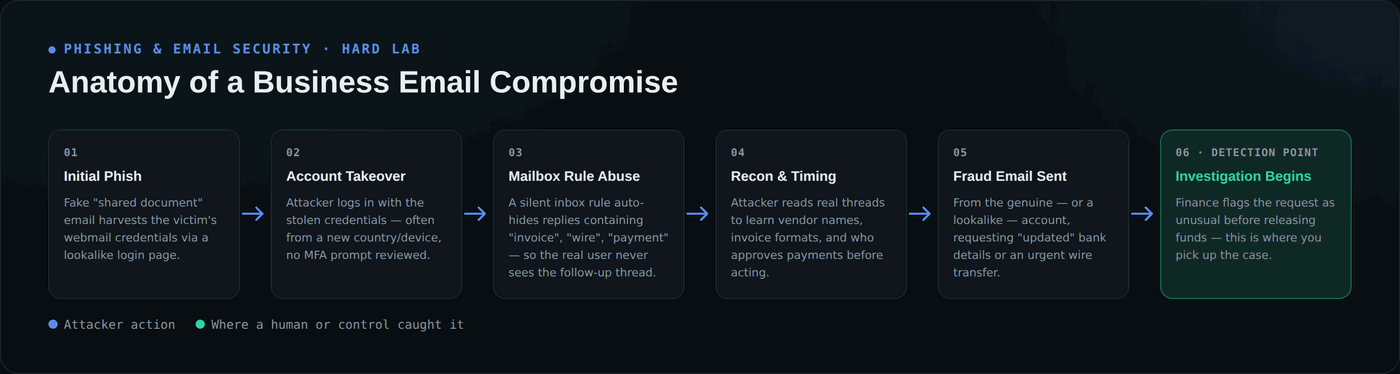
Every real BEC case looks roughly like this. Your job below is filling in the specifics — the actual timestamps, IOCs, and evidence — for this case.
Evidence
Five artifacts were pulled from Argosy Freight's mail system and identity logs. Review each one, form your own read, then expand the analyst notes to check yourself.
The Initial Phishing Email
Pulled from Priya Raman's mailbox, dated two days before the fraud email was sent.
Open Q3-Vendor-Statement.xlsx →
| Field | Value |
|---|---|
| Envelope sender | notify@sharepoint-docs-view.example |
| Link destination | argosyfreight-sso-verify.example/login |
| Authentication | spf=fail, dkim=none, dmarc=fail |
Reveal Analyst Notes
Sign-In Log — Priya Raman's Account
Identity provider audit log for the two weeks around the incident.
| Date / Time (UTC) | Source IP | Location | Client | MFA | Result |
|---|---|---|---|---|---|
| Aug 05, 09:14 | 203.0.113.18 | Chennai, IN | Outlook Mobile | Satisfied | Success |
| Aug 09, 08:47 | 203.0.113.18 | Chennai, IN | Outlook Web | Satisfied | Success |
| Aug 12, 19:03 | 198.51.100.231 | Unknown VPN — Eastern Europe | Legacy IMAP4 | Not required | Success |
| Aug 12, 19:05 | 198.51.100.231 | Unknown VPN — Eastern Europe | Outlook Web | Not required | Success |
| Aug 14, 22:40 | 198.51.100.231 | Unknown VPN — Eastern Europe | Outlook Web | Not required | Success |
Reveal Analyst Notes
Mailbox Rule Created
Mailbox audit log entry, six minutes after the first anomalous sign-in.
Mailbox: priya.raman@argosyfreight.example
Created: 2026-08-12 19:06:41 UTC
Rule name: "."
Condition: Subject or body contains "invoice", "wire", "payment", "bank", "remittance"
Action: Move to RSS Subscriptions folder; mark as read; stop processing more rules
Reveal Analyst Notes
The Fraud Email
Sent from Priya's genuine, fully-authenticated mailbox. (Full header breakdown also covered as Case 2 in the Medium lab.)
New Bank Details (PDF) →
From: "Priya Raman — Argosy Freight" <priya.raman@argosyfreight.example>
To: ap@client.example
Subject: Re: Invoice #4471 — please use our new bank details
Date: Fri, 14 Aug 2026 22:47:03 +0000
References: <4471-orig@argosyfreight.example>
Received: from mail.argosyfreight.example (mail.argosyfreight.example [203.0.113.90])
        by mx.client.example; Fri, 14 Aug 2026 22:47:19 +0000
Authentication-Results: mx.client.example;
    spf=pass smtp.mailfrom=argosyfreight.example;
    dkim=pass header.d=argosyfreight.example;
    dmarc=pass (p=REJECT) header.from=argosyfreight.example
Bank Details — Before vs. Requested
| Field | On File (Vendor Master) | Requested in Fraud Email |
|---|---|---|
| Bank name | First Continental Bank | Meridian Pacific Trust |
| Account (last 4) | ••4471 | ••9902 |
| Routing / IFSC | 021000021 | 098001129 |
Reveal Analyst Notes
Reconstructed Timeline
Once you've reviewed all five pieces of evidence, here's how they chain together.
Reveal Full Timeline
Indicators of Compromise
What you'd hand to the email gateway, EDR, and firewall teams to hunt for and block.
| Type | Indicator |
|---|---|
| Phishing sender domain | sharepoint-docs-view.example |
| Credential-harvest domain | argosyfreight-sso-verify.example |
| Attacker source IP | 198.51.100.231 |
| Malicious inbox rule name | "." (single period) |
| Fraudulent bank — name | Meridian Pacific Trust |
| Fraudulent bank — account (last 4) | 9902 |
Writing It Up
This is what a completed incident summary for INC-2026-0814 looks like — the deliverable this whole investigation was building toward.
Incident Summary Report
INC-2026-0814 · Business Email CompromiseExecutive Summary
Priya Raman's mailbox (priya.raman@argosyfreight.example) was compromised via a credential-phishing email on Aug 12, 2026. The attacker authenticated using legacy IMAP4 without an MFA challenge, created a concealment inbox rule, and on Aug 14 used the account to send a fraudulent bank-detail-change request for a $184,500 vendor payment. The receiving client's AP team identified the mismatched bank details before releasing funds. No confirmed financial loss as of this report.
Root Cause
Successful credential phishing, combined with legacy authentication (IMAP4) that allowed sign-in without satisfying the tenant's MFA policy.
Impact
No funds released. Exposure of internal AP correspondence to the attacker for approximately two days. Reputational/trust impact with the affected vendor contact pending outreach.
Remediation Actions
- Reset Priya Raman's credentials and revoke all active sessions and refresh tokens.
- Force MFA re-registration before the account can authenticate again.
- Disable legacy authentication protocols (IMAP4, POP3, legacy SMTP AUTH) tenant-wide.
- Remove the malicious inbox rule and audit all mailboxes for similarly-named rules.
- Block identified IOCs at the email gateway and firewall.
- Contact the client's AP team directly by phone to confirm no funds were released and the fraud email should be disregarded.
- Enable Conditional Access policies to block sign-ins from unexpected locations / impossible travel.
- Run BEC-specific awareness training for AP and Finance staff, focused on out-of-band verification for any payment-detail change.
Why This Matters
How to Detect & Protect
- Disable legacy authentication protocols (IMAP4, POP3, legacy SMTP AUTH) tenant-wide — they're a well-known way to bypass modern MFA enforcement entirely.
- Alert on new inbox rules that move, delete, or mark-as-read messages matching financial keywords — this is one of the highest-signal BEC indicators available and is rarely monitored by default.
- Require out-of-band verification for any bank-detail or payment-instruction change — a phone call to a number already on file, never one supplied in the email itself.
- Enable Conditional Access / impossible-travel alerting so a sign-in from an unexpected country triggers review, even when it technically succeeds.
- Treat "the account is genuine" as the start of an investigation, not the end — reconstruct the full timeline (sign-ins, rules, sent mail) rather than judging a single message in isolation.
- Train Finance/AP staff specifically on BEC, separate from general phishing awareness — the psychological pressure and business context are what make it work.